
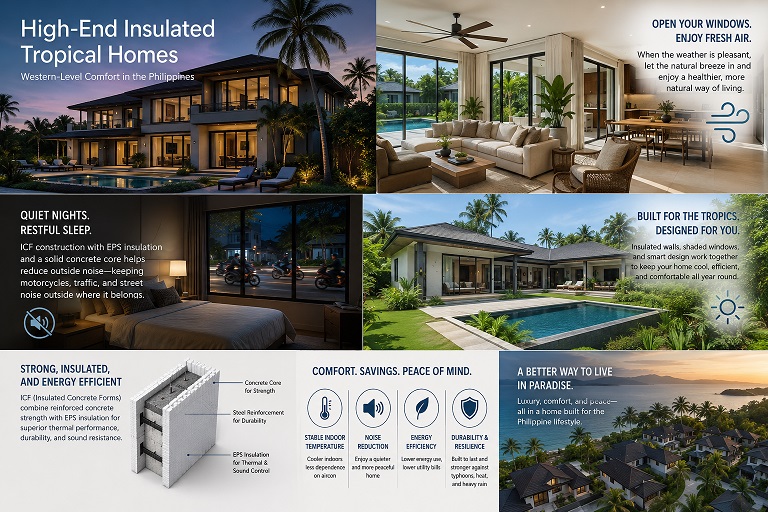
Luxury Living Should Not Mean Choosing Between Comfort and the Tropical Lifestyle
The Philippines offers something that few places in the world can match: warm weather, beautiful coastlines, friendly communities, affordable living, and an extraordinary tropical lifestyle.
For foreigners, retirees, OFWs returning home, and affluent Filipinos, the Philippines can be an ideal place to build a permanent residence, retirement home, vacation property, or family estate.
But there are concerns that many people have when considering a home in the Philippines:
The heat.
The humidity.
And sometimes, the noise.
Someone accustomed to a well-insulated home in North America, Europe, Australia, or another temperate climate may be surprised by how differently many conventional Philippine homes are designed.
In a tropical country, keeping a home comfortable is not simply a matter of installing a larger air-conditioning system.
And creating a peaceful home is not simply a matter of finding a quiet neighborhood.
The building itself matters.
Its walls, roof, windows, orientation, shading, ventilation, insulation, and construction all influence how much heat and outside noise enter the home.
This is where a new generation of high-performance insulated tropical homes can offer a different approach.
What If You Could Have Both?
Imagine living in the Philippines while enjoying the tropical lifestyle outside your home—and a comfortable, carefully controlled environment inside.
Imagine returning home after a hot afternoon and entering a residence designed to minimize unwanted heat transfer.
Imagine bedrooms that remain comfortable at night.
Imagine large windows overlooking a garden, pool, mountain or ocean view without allowing uncontrolled solar heat gain to dominate the interior.
And imagine something else:
Opening those windows on a comfortable morning or afternoon and letting the fresh tropical air move naturally through your home.
You don’t necessarily have to keep the windows closed and the air-conditioning running all day.
When outdoor conditions are comfortable enough, a properly designed insulated home can give you the option of natural ventilation and fresh-air living.
This is one of the most attractive possibilities of a high-performance tropical home:
Use the air-conditioner when you need it. Open the windows when you don’t.
But there is another benefit that is particularly valuable in the Philippines:
When the windows are closed, a properly designed insulated building envelope can also help create a quieter interior.
A Quieter Home in a Noisy Environment
Anyone who has spent time living in the Philippines knows that tropical living comes with its own unique soundscape.
Motorcycles and scooters are a common sight on Philippine streets.
Depending on where a property is located, homeowners may also hear:
- Motorcycle engines
- Tricycles
- Jeepneys
- Cars and trucks
- Road traffic
- Horns
- Neighborhood activity
- Construction
- Dogs
- Outdoor conversations
- Commercial activity
For many people, these sounds are simply part of everyday Philippine life.
But when you’re trying to sleep at night, they can become a very different matter.
A motorcycle passing outside at midnight can be surprisingly disruptive.
For foreigners, retirees and homeowners accustomed to quieter residential environments, acoustic comfort can be just as important as thermal comfort.
This is another area where an insulated home can make a meaningful difference.
ICF Can Help Keep the Outside Noise Outside
Insulated Concrete Form construction is not only about thermal performance.
The wall assembly itself can also provide significant resistance to airborne sound transmission.
ICF walls combine a reinforced concrete core with continuous EPS insulation.
The combination of mass + insulation + a solid wall assembly can help reduce the amount of outside airborne noise that reaches the interior.
That can make a noticeable difference when the home is located near a road or other source of outdoor activity.
The result is not necessarily a completely soundproof house—and no responsible builder should promise that.
Instead, the goal is something more useful:
A quieter, more peaceful interior.
Imagine going to bed at night with the windows and doors closed and hearing considerably less of the activity happening outside.
The motorcycles are still there.
The road is still there.
The neighborhood is still there.
But the house creates a much stronger acoustic separation between your private interior environment and the outside world.
Why This Matters at Night
A luxury home should provide a good night’s sleep.
This is particularly important for retirees, homeowners who work from home, families with young children, and people who simply value peace and quiet.
Consider a bedroom facing a busy street.
In a conventional lightweight wall assembly, outside traffic noise can penetrate the building relatively easily.
With a properly engineered high-mass, insulated wall system, much more of that sound energy can be reduced before reaching the interior.
But the walls are only one part of the acoustic system.
Windows and doors can be just as important.
That is why a high-performance tropical home should consider:
ICF or other high-performance insulated walls
Acoustically appropriate windows
Well-sealed doors
Proper roof construction
Careful placement of bedrooms
Landscape and site planning
Together, these elements can create a significantly quieter home.
The Luxury of Silence
At the high end of the market, luxury isn’t always about adding another room.
Sometimes it is about removing things you don’t want.
Less heat.
Less glare.
Less humidity.
Less outside noise.
Less energy waste.
Less maintenance.
And more comfort.
This is why acoustic performance can become a genuine luxury feature.
Imagine closing your bedroom door at night and experiencing a peaceful interior environment while the activity of the street continues outside.
For someone spending ₱18 million, ₱20 million, or ₱25 million on a residence, that kind of comfort can be far more valuable than another few square meters of floor area.
A Home With Two Modes of Comfort
A high-performance tropical home can be designed around two complementary modes.
Natural Comfort Mode
When outdoor conditions are favorable:
Windows open
→ Fresh outdoor air enters
→ Cross-ventilation moves air through the rooms
→ Fans can improve air movement
→ Air-conditioning can remain off
→ The house feels naturally ventilated
Conditioned & Quiet Comfort Mode
When outdoor conditions become too hot, humid or noisy:
Windows close
→ The insulated building envelope helps slow heat transfer
→ ICF walls help reduce airborne sound transmission
→ Efficient air-conditioning maintains the desired indoor environment
→ Properly sealed windows and doors help limit outside noise
→ Smart controls can manage temperature and energy use
The homeowner gets something that a conventional house may struggle to provide:
Choice.
Open the house when the weather is pleasant.
Close it when the heat, humidity or noise outside becomes undesirable.
Fresh Air Without Giving Up Comfort
For many people coming from countries with cooler climates, opening the windows is a fundamental part of enjoying a home.
You wake up.
You open the curtains.
You open the windows.
Fresh air enters.
You hear the birds.
You feel the breeze.
The house feels connected to its surroundings.
In a conventional Philippine house, however, opening the windows during a hot period can quickly introduce uncomfortable heat and humidity.
It can also introduce traffic noise.
A high-performance tropical home approaches the problem differently.
By combining appropriate insulation with carefully planned natural ventilation, shading, window placement, acoustic design and building orientation, the home can be designed to take advantage of favorable outdoor conditions while minimizing unwanted heat gain and noise when the windows are closed.
The result is a house that can adapt to the weather and environment instead of relying on a single strategy.
Insulation for Comfort. Mass for Quiet.
One of the attractive characteristics of ICF construction is that the wall assembly performs multiple functions.
The EPS insulation helps reduce heat transfer.
The concrete core provides mass and structural strength.
Together, they can contribute to both thermal comfort and acoustic separation.
This is particularly valuable in the Philippines because the same wall can address two very different problems:
During the day:
The insulation helps reduce unwanted heat entering the home.
At night:
The substantial wall assembly can help reduce outside airborne noise reaching the bedroom.
The result is a home designed around two things every homeowner wants:
A cooler interior.
A quieter interior.
But the Whole House Still Matters
ICF is not a magic soundproofing system.
A home’s actual acoustic performance depends on the entire building envelope.
A high-performance residence should therefore consider:
- ICF wall construction
- EPS insulation
- High-quality windows
- Properly sealed doors
- Roof and ceiling construction
- Mechanical equipment
- Air-conditioning units
- Plumbing noise
- Interior partitions
- Building orientation
- Bedroom placement
- Landscaping
- Boundary walls
- Distance from roads
If the walls are highly insulated but the house has large single-pane windows with significant air leakage, outside noise can still enter.
For this reason, acoustic performance should be designed as a system, just like thermal performance.
Western-Style Comfort, Tropical Architecture
This is where the concept becomes especially interesting for foreign homeowners and returning Filipinos.
A high-performance home does not have to look like a house from Canada, Germany, Britain, or the United States.
In fact, it shouldn’t.
The best solution is to combine high-performance building technology with tropical architecture.
Imagine:
- Large shaded windows
- Deep roof overhangs
- Natural stone
- Warm timber
- Tropical landscaping
- High ceilings
- Covered outdoor living spaces
- Private courtyards
- Swimming pools
- Outdoor kitchens
- Seamless indoor-outdoor transitions
- Carefully controlled sunlight
- Modern insulated walls
- High-quality air-conditioning
- Smart-home technology
- Acoustic privacy
- Quiet bedrooms
The result is not a foreign house transplanted into the Philippines.
It is a Philippine home designed to deliver a higher level of comfort.
Who Is the High-Performance Tropical Home For?
Foreigners Living in the Philippines
For foreigners planning to retire, relocate, or spend significant portions of the year in the Philippines, the comfort of their home can be one of the most important considerations.
The ability to enjoy the tropical lifestyle without feeling overwhelmed by the heat—or disturbed by unnecessary outside noise—can make a major difference in the long-term living experience.
A properly designed insulated residence can help bridge the gap between the comfort expectations of a homeowner’s previous country and the realities of the Philippine climate.
Retirees
Retirement should be comfortable.
For someone investing millions of pesos into a permanent retirement residence, it makes sense to consider the long-term performance of the building rather than focusing only on its appearance.
A retirement home should be:
Comfortable. Quiet. Secure. Efficient. Durable. Easy to maintain.
These qualities can be incorporated into the design from the beginning.
OFWs and Returning Filipinos
Many OFWs spend years working overseas and become accustomed to different standards of housing, construction and indoor comfort.
When they return to the Philippines, they may want more than simply a larger house.
They may want a home that incorporates the quality, technology and comfort they experienced abroad.
A high-performance tropical residence can provide exactly that.
Affluent Filipino Families
For successful Filipino families, a luxury home is increasingly about more than demonstrating wealth.
It is about creating a place where the family can live, entertain, relax and spend time together.
That means comfortable bedrooms, beautiful living spaces, excellent kitchens, private outdoor areas, home offices, entertainment rooms, pools, gardens and technology—all integrated into one coherent architectural design.
Luxury Is More Than Expensive Finishes
A ₱20 million home should not simply contain ₱20 million worth of finishes.
True luxury is often found in things that are difficult to see.
It is in the quality of the waterproofing.
The precision of the windows.
The performance of the roof.
The electrical infrastructure.
The plumbing.
The air-conditioning design.
The acoustics.
The insulation.
The drainage.
The structural system.
The quality of the workmanship.
These are the things that determine how the home performs after the excitement of moving in has disappeared.
Luxury is not simply what you see.
It is what you experience every day.
A High-Performance Home Can Also Be a More Resilient Home
ICF construction can provide benefits beyond thermal and acoustic performance.
Because ICF walls incorporate a reinforced concrete core, the system can provide substantial structural strength when properly engineered.
For a country exposed to typhoons, heavy rainfall and other environmental stresses, resilience is an important consideration.
However, the performance of the finished building depends on the complete structural design, engineering, materials and construction quality.
ICF is a building system—not a substitute for professional engineering.
Designing the Entire Home as a System
The most important principle is simple:
Don’t design an ICF house. Design a high-performance house that happens to use ICF.
The wall system is only one part of the solution.
A truly premium residence should consider the entire building as a system:
Site
↓
Orientation
↓
Solar control
↓
Shading
↓
Roof insulation
↓
High-performance walls
↓
Windows and doors
↓
Acoustic control
↓
Natural ventilation
↓
Humidity control
↓
Efficient cooling
↓
Smart controls
↓
Renewable-energy readiness
When all of these components are considered together, the result can be significantly better than simply adding insulation to an otherwise conventional house.
The Future of Luxury Homes in the Philippines
The Philippine luxury-home market is changing.
Today’s affluent homeowner has access to better technology, better materials, better architectural information and greater awareness of energy efficiency than previous generations.
Foreign residents and retirees bring their own expectations of indoor comfort.
OFWs return home with experience of different construction standards.
Affluent Filipino families increasingly expect their homes to provide not only status, but also comfort, privacy, convenience and long-term value.
This creates an opportunity for a new category of residential construction:
High-Performance Tropical Luxury Homes.
These are homes designed specifically for the Philippine climate while incorporating the comfort, quality and technology expected from premium international residential construction.
Your Tropical Home Should Feel Like Home
The Philippines should not require you to choose between tropical living and indoor comfort.
You can have the garden.
The pool.
The ocean view.
The mountain view.
The outdoor kitchen.
The tropical landscaping.
The open-air entertaining spaces.
And at the same time, you can have a carefully engineered interior environment designed to remain comfortable in one of the world’s hottest and most humid climates.
You can even have something many homeowners value just as much as temperature control:
peace and quiet.
The motorcycles may still be passing on the road.
The neighborhood may still be active.
The tropical life continues outside.
But inside, your home can provide a much greater degree of separation from the outside environment.
The answer is not simply a bigger air-conditioner.
It starts with the building itself.
Better insulation.
Better shading.
Better windows.
Better roofs.
Better natural ventilation.
Better acoustic control.
Better engineering.
Better construction.
And, where appropriate, advanced wall systems such as Insulated Concrete Forms (ICF).
Build for the Climate. Build for Comfort. Build for Peace.
A luxury home in the Philippines should do more than look impressive.
It should make you feel comfortable when you wake up.
Relaxed when you come home.
Confident during extreme weather.
Proud when you entertain.
Able to enjoy fresh air when the weather permits.
And able to retreat into a quieter, more peaceful interior when the outside world becomes hot, humid or noisy.
For foreigners, retirees, OFWs and affluent Filipino families looking for a premium residence in the Philippines, the next generation of luxury homes is not simply about building bigger.
It is about building smarter.
A tropical home should embrace the climate outside while giving you exceptional comfort inside.
And when the weather outside is pleasant enough, you should be able to open the windows, let the fresh air in, and enjoy your home naturally.
When the street becomes noisy at night, you should be able to close the windows and retreat into a quieter interior.
Cool when you want it.
Fresh when you want it.
Quiet when you need it.
Luxury when you deserve it.
That is the freedom of a high-performance tropical home.

Feedback