
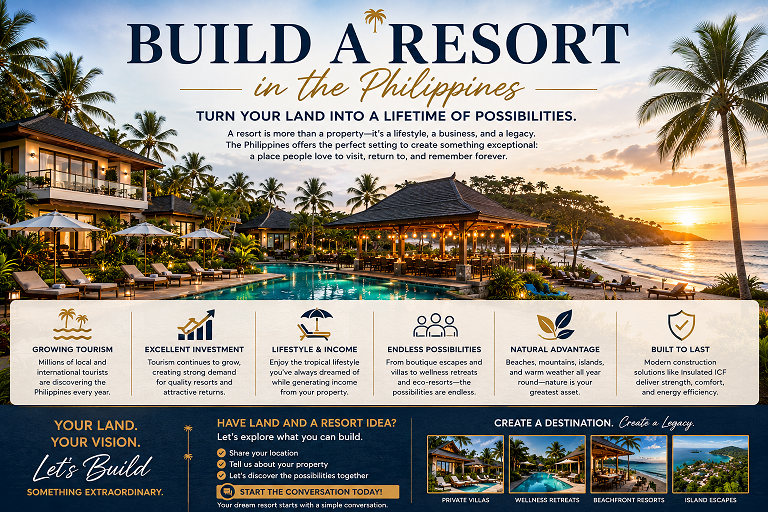
“What could I build here?”
For investors from the Philippines and abroad, owning land in a beautiful destination can be the beginning of something much bigger than a vacation home. Depending on the location, land characteristics, target market, and available capital, the property could potentially become a boutique resort, a collection of private villas, a wellness retreat, a family destination, or a combination of personal and commercial accommodation.
But one of the first questions every investor eventually asks is:
“How much does it cost to build a resort in the Philippines?”
There is no single answer.
A ₱30-million development can look completely different from a ₱50-million development. A ₱100-million investment can create an entirely different type of resort again.
The important question is not simply “How much does a resort cost?”
The better question is:
“What kind of resort can I realistically create with my available budget, land and location?”
This guide explores the possibilities.
Why the Philippines Is Attractive for Resort Development
The Philippines offers something that many investors from colder countries find difficult to resist:
tropical living combined with a growing tourism market.
The country offers thousands of islands, beaches, mountains, diving destinations, waterfalls, cultural attractions and increasingly popular secondary tourism destinations.
For some investors, the attraction is purely commercial.
For others, it is personal.
They may want to build somewhere they can:
- escape cold winters
- retire
- spend several months a year
- accommodate family and friends
- generate rental income
- operate a hospitality business
- create a long-term investment
- eventually develop a larger resort
This combination makes resort development particularly interesting.
You don’t necessarily have to choose between investment and lifestyle.
A well-planned property can potentially provide both.
What Determines the Cost of a Philippine Resort?
Before discussing budgets, it is important to understand why two resorts with the same number of rooms can have dramatically different construction costs.
The final cost depends on factors including:
1. Location
Building in an established tourism center with good road access and utilities can be very different from building on a remote island or mountain property.
2. Land conditions
A relatively flat, accessible property is generally easier to develop than steep, rocky, flood-prone or difficult-to-access terrain.
3. Number and size of rooms
Ten compact guest rooms and ten large luxury villas are obviously very different projects.
4. Construction quality
There is a major difference between basic accommodation and a premium resort designed for international guests.
5. Swimming pools and recreational facilities
Pools, restaurants, spas, event spaces, landscaping and other amenities can significantly change the development budget.
6. Infrastructure
Depending on the location, you may need to consider:
- water systems
- sewage treatment
- electrical systems
- backup power
- roads
- drainage
- retaining walls
- parking
- staff facilities
- kitchens
- laundry facilities
- internet infrastructure
7. Architecture and engineering
A resort isn’t simply a collection of rooms.
It needs to function as a business.
Good planning can determine how guests move through the property, how staff operate it, how supplies arrive, how maintenance is performed and how much of the site is actually generating revenue.
What Can You Build With ₱30 Million?
A ₱30-million budget can potentially be enough to create a small boutique resort, depending heavily on land cost, site conditions, specifications and what is included in the budget.
The emphasis should usually be on quality rather than excessive scale.
A conceptual development might include:
- several guest rooms or villas
- swimming pool
- reception area
- small restaurant or café
- landscaped outdoor areas
- parking
- basic staff/service facilities
- attractive common areas
Rather than attempting to build a miniature version of a large hotel, an investor with this budget may be better served by creating a distinctive boutique property.
Think:
fewer rooms + better experience + stronger identity.
A beautiful six- or eight-villa resort in the right location can potentially be more attractive than a larger development that feels ordinary.
The exact number of rooms, of course, should be determined only after evaluating the land, design, construction specifications and project requirements.
What Can You Build With ₱50 Million?
At approximately ₱50 million, the possibilities become considerably broader.
Depending on the site and specifications, a conceptual development could potentially include:
- more guest rooms or villas
- larger swimming pool
- restaurant
- reception/lobby
- improved landscaping
- event or function area
- upgraded guest facilities
- better staff/service infrastructure
- stronger architectural identity
This is where an investor can begin thinking about a true destination experience rather than simply accommodation.
For example:
The Tropical Villa Resort
Imagine a property consisting of individual villas arranged around a landscaped tropical environment.
Guests aren’t simply renting a room.
They’re renting:
privacy + space + tropical surroundings + pool + resort experience.
This model can be particularly appealing to couples, families, long-stay visitors and travelers looking for something more intimate than a conventional hotel.
What Can You Build With ₱100 Million?
A ₱100-million-plus budget opens up substantially more possibilities.
Instead of simply asking:
“How many rooms can I build?”
you can begin asking:
“What kind of destination can I create?”
A larger development could potentially incorporate:
- multiple accommodation types
- premium villas
- hotel-style rooms
- restaurant
- large swimming pool
- spa/wellness facilities
- events area
- recreation facilities
- landscaped gardens
- larger reception facilities
- staff accommodation
- expanded back-of-house facilities
- stronger sustainability and energy systems
The development could be designed around a specific market.
For example:
Luxury Island Retreat
Target couples, honeymooners and high-spending international travelers.
Wellness Resort
Focus on relaxation, health-oriented experiences, yoga, nature and longer stays.
Family Resort
Larger rooms, pools, activities and family-friendly amenities.
Boutique Eco-Resort
Focus on nature, privacy, architecture and environmental integration.
Retirement / Long-Stay Resort
Designed around guests who want to stay for weeks or months rather than just a weekend.
The larger the budget becomes, the more important master planning becomes.
What About ₱150 Million, ₱200 Million or More?
At this level, you shouldn’t simply be thinking about “building more rooms.”
You should be thinking about building an entire hospitality concept.
A larger investment could potentially support a more comprehensive resort development with:
Accommodation + food and beverage + recreation + wellness + events + landscaping + guest experiences.
The property might include different accommodation categories and multiple revenue streams.
For example:
Villa accommodation
Restaurant
Beach club
Pool
Wellness/spa
Events
Activities
Long-stay accommodation
This can create a much more sophisticated resort business model.
But there is an important principle:
More money does not automatically create a better resort.
Good planning does.
Don’t Build the Biggest Resort You Can Afford
One of the biggest mistakes a first-time resort investor can make is thinking:
“I have ₱100 million, therefore I should spend ₱100 million.”
That’s not necessarily the right approach.
Instead ask:
What does the market want?
What does the location support?
What can the property physically accommodate?
How many rooms can realistically be operated?
What facilities will actually generate revenue?
What will maintenance cost?
How much capital should remain available for operations?
What happens if occupancy takes longer to build?
A resort is not finished when construction ends.
That’s when the business begins.
The Land You Own May Be More Important Than Your Budget
Imagine two investors.
Investor A has ₱80 million and a flat, accessible property near an established tourism destination.
Investor B has ₱80 million but owns a difficult mountainous property with poor access and limited utilities.
They have the same budget.
They do not have the same development opportunity.
This is why resort planning should start with the property.
Before deciding what to build, examine:
- location
- road access
- topography
- views
- coastline
- existing vegetation
- water availability
- electrical supply
- drainage
- neighboring properties
- local regulations
- environmental considerations
- tourism demand
- target customers
Sometimes the best resort design is the one that works with the land instead of fighting it.
Why Smaller Boutique Resorts Can Be Attractive
There is a growing appeal to properties that don’t feel like conventional hotels.
Many travelers are looking for:
- privacy
- beautiful views
- unique architecture
- nature
- quiet surroundings
- personalized service
- private pools
- larger rooms
- memorable experiences
This creates an opportunity for smaller investors.
You don’t necessarily need hundreds of rooms.
A carefully designed boutique resort with a smaller number of premium accommodations can create a very different guest experience.
The objective is not:
“How many rooms can we squeeze onto the property?”
It can instead be:
“How valuable can we make each guest’s experience?”
Build for the Philippine Climate
There is another issue that investors—particularly those coming from colder countries—should think about early:
heat.
A resort can look spectacular in architectural drawings and still be uncomfortable if the building envelope is poorly designed for a tropical climate.
Large amounts of glass, poorly insulated walls, poorly designed roofs and uncontrolled solar heat gain can increase the cooling burden.
That is why the building envelope deserves serious attention.
Why Consider Insulated ICF Construction?
One technology worth discussing during resort planning is Insulated Concrete Forms (ICF).
ICF construction combines reinforced concrete with continuous insulation, creating a building envelope designed to provide structural strength together with insulation.
For a Philippine resort, this can offer several potential advantages:
Improved thermal performance
Insulation can reduce heat transfer through the building envelope.
Greater indoor comfort
A properly designed insulated building can help maintain a more stable indoor environment.
Reduced dependence on air-conditioning
Better thermal performance can potentially reduce cooling demand, although actual savings depend on the entire building design, orientation, windows, roof, ventilation, equipment and operating practices.
Sound reduction
The combination of concrete and insulation can also provide useful acoustic performance—an attractive feature for resort rooms.
Durability
Reinforced concrete construction can provide a robust building system when properly designed and constructed.
The important point is not simply:
“Use ICF because it’s modern.”
The better argument is:
Design the resort around the Philippine climate from the beginning.
Imagine a Resort Designed Around Guest Comfort
Consider a guest arriving at a tropical resort after spending the day outdoors.
They’ve been walking on the beach.
They’ve been swimming.
They’ve been exploring waterfalls.
They’ve been hiking.
They return to their villa.
They open the door.
Instead of feeling like they have entered another hot box, they experience a comfortable, quiet interior.
That experience matters.
Because the resort isn’t just selling:
a room.
It is selling:
comfort.
And comfort is part of the product.
Cebu, Bohol, Siquijor, Camiguin and Beyond
The Philippines gives investors a wide range of possible resort environments.
Cebu
A particularly interesting option for investors who want a combination of tourism, infrastructure, accessibility and a large potential market.
Bohol
An established tourism destination with beaches, diving, nature attractions and international visitor appeal.
Siquijor
An island environment that can appeal to investors looking for a more intimate, nature-oriented and slower-paced destination.
Camiguin
An attractive option for investors interested in combining beaches, mountains, waterfalls, hot springs and a quieter island atmosphere.
Negros
Offers diverse development possibilities ranging from coastal destinations to mountain and nature-oriented properties.
The best location isn’t necessarily the place with the highest tourist count.
It may be the place where:
land + access + tourism + competition + investment budget + target market
come together most effectively.
What Kind of Resort Investor Are You?
Before building, determine which category best describes you.
The Lifestyle Investor
You want a beautiful property for yourself and your family, but you want the resort to generate income when you’re not using it.
The Retirement Investor
You want somewhere to live while generating hospitality income.
The Pure Investor
Your primary objective is a commercially viable tourism project.
The Landowner
You already own the property and want to determine its highest and best use.
The Resort Owner
You already operate a resort and want to expand.
The Foreign Investor
You live in a colder country and want to create a tropical base in the Philippines.
Each investor requires a different strategy.
Don’t Start With Construction
This may sound strange coming from a construction company, but it is important:
Don’t start by asking how quickly you can build.
Start by asking:
What should be built?
Then:
Who is going to stay there?
Then:
Why will they choose this resort instead of the alternatives?
Then:
What will the development cost?
Then:
How will it operate?
Only after those questions have been considered should the construction strategy be finalized.
Your Land Could Be Worth More Than You Think
A beautiful piece of Philippine property can represent much more than its value as vacant land.
With the right planning, it could potentially become:
A family retreat
A retirement property
A boutique resort
A villa development
A wellness destination
A vacation rental business
Or a combination of several of these.
The key is discovering what the property is capable of becoming.
Thinking About Building a Resort in the Philippines?
If you already own land—or are considering purchasing property for a resort development—you don’t have to begin with a finished set of architectural drawings.
Start with a conversation.
Tell us:
Where is the property?
How large is it?
Is it beachfront, mountain, inland or island property?
What approximate budget are you considering?
What kind of resort are you imagining?
From there, the possibilities can be explored.
Whether your budget is around ₱30 million, ₱50 million, ₱100 million or considerably more, the objective should not simply be to spend the available money.
It should be to create the right resort for the right property and the right market.
And if you’re coming from a colder country, there’s another question worth asking:
Why merely visit paradise when you could build something of your own there?
Have Philippine land and a resort idea?
Let’s explore what you could build.

Feedback