There are still churches in Northern Cebu that are still closed or remain unfixed due to lack of funds.
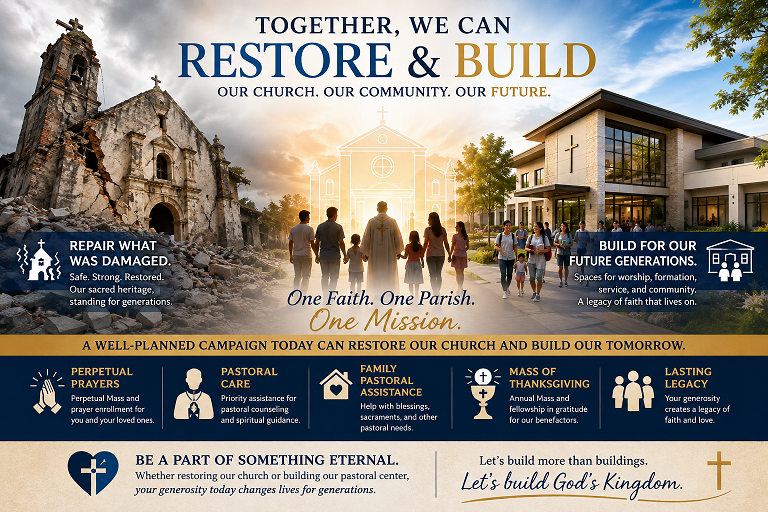
Across Cebu, many parishes have experienced the devastating effects of earthquakes, typhoons, age, and years of deferred maintenance.
The September 30, 2025 earthquake caused serious damage to churches across northern Cebu, including historic churches in Daanbantayan, Bantayan, Tabogon, San Remigio and Bogo. Government and church agencies have been involved in assessment, planning, heritage preservation and rehabilitation efforts, but the scale and complexity of the work means that funding remains a major part of the challenge.
The Archdiocese of Cebu has reported ongoing rehabilitation efforts, including structural engineering planning for numerous affected churches.
For some parishes, the urgent question is:
“How do we raise enough money to repair our church and safely bring our parish community back into a proper place of worship?”
For other parishes whose churches remain functional, the question may be:
“How can we raise the funds to build the pastoral facilities our growing parish needs?”
Both problems have something important in common:
They need a well-planned fundraising strategy.
And in many cases, the answer may begin with major benefactors.
A New Approach to Parish Building Projects
When people hear “church construction,” they often immediately think of a contractor.
The contractor provides a quotation.
The parish tries to find the money.
Construction begins when enough money has been collected.
But there is another way to approach the problem.
Start with the funding strategy.
Before construction begins, develop:
- the vision;
- the project scope;
- the technical requirements;
- the preliminary cost;
- the fundraising target;
- the major-donor strategy;
- the donor presentation;
- the construction phases;
- and the financial controls.
Then build the project around the funding that can realistically be obtained.
This approach can be particularly useful for parishes that have been waiting for years because they simply don’t know where the money for a major repair or construction project will come from.
Two Parish Problems—One Fundraising Strategy
OPTION 1: Repair and Restore a Damaged Church
For a parish whose church has suffered earthquake or structural damage, the first priority is obviously safety and appropriate technical assessment.
The process could begin with:
1. Structural Assessment
Determine the actual condition of the building through qualified structural engineers and other appropriate professionals.
2. Scope of Work
Determine what needs to be:
- repaired;
- strengthened;
- reconstructed;
- replaced;
- preserved;
- or temporarily supported.
For heritage churches, conservation requirements and coordination with appropriate cultural and heritage authorities may also be necessary.
3. Realistic Cost
Develop a professional preliminary budget.
Instead of simply saying:
“We need money to repair the church.”
the parish can say:
“The estimated rehabilitation program is ₱XX million, divided into these specific phases.”
4. Fundraising Campaign
Approach major benefactors with a clear restoration vision.
5. Construction in Phases
For example:
Phase 1 — Structural stabilization
↓
Phase 2 — Major structural repair
↓
Phase 3 — Roofing and weather protection
↓
Phase 4 — Electrical and plumbing rehabilitation
↓
Phase 5 — Interior restoration
↓
Phase 6 — Furnishings and final works
This can allow fundraising and construction to progress together.
OPTION 2: Build a New Pastoral Center
For a parish whose church remains structurally sound but whose pastoral facilities are inadequate, the opportunity is different.
Instead of repairing a damaged structure, the parish can develop a Pastoral Center Building Campaign.
The center could provide space for:
- parish administration;
- catechism;
- youth ministry;
- Bible studies;
- marriage preparation;
- counseling;
- parish organizations;
- formation programs;
- charitable activities;
- meetings;
- training;
- and community outreach.
Again, the process begins with a clear vision and preliminary budget.
Then the fundraising campaign is built around the project.
Why Major Benefactors Can Make the Difference
For a large project, one of the fastest ways to build momentum can be to identify people who have the capacity and willingness to make substantial contributions.
These may include:
- wealthy parishioners;
- business owners;
- former parishioners;
- successful families who grew up in the parish;
- overseas parishioners;
- alumni of parish schools;
- local corporations;
- foundations;
- and friends of the parish.
Instead of asking everyone for a small amount, the parish can establish a Major Benefactor Campaign.
For example:
Founding Patron
₱2,000,000+
Legacy Benefactor
₱1,000,000+
Major Benefactor
₱500,000+
Pastoral Partner
₱250,000+
Building Patron
₱100,000+
The actual amounts should depend on the size of the project and the parish’s donor community.
The purpose isn’t to pressure wealthy people.
It is to give people who genuinely want to make a substantial contribution an opportunity to create a lasting legacy for their parish.
Don’t Just Ask for Money—Show What It Accomplishes
A major donor is much more likely to respond to a specific, tangible opportunity.
Instead of:
“Would you donate ₱1 million to our church?”
the parish can say:
“Would your family consider sponsoring the structural rehabilitation of this section of the church?”
or:
“Would you consider helping us build the Parish Formation Hall?”
or:
“Would your family consider becoming one of the Founding Benefactors of the new Pastoral Center?”
A professional rendering, floor plan, structural assessment, project budget and construction schedule can turn an abstract fundraising request into something donors can actually understand.
Give Benefactors a Meaningful Spiritual Connection
A major donor’s motivation isn’t necessarily financial recognition.
For many Catholic benefactors, the opportunity to support the spiritual life of the parish can be deeply meaningful.
Subject to parish and diocesan approval, a Founding Benefactors or Legacy Benefactors program could include:
Perpetual Prayer and Mass Enrollment
A special prayer or Mass card can commemorate the benefactor and communicate the parish’s commitment to remembering the donor and family in its ongoing prayers and Mass intentions, according to the parish’s actual practices.
The message is:
“Your generosity helped strengthen the spiritual life of this parish, and we will remember you and your family in our prayers.”
Benefactor Pastoral Care
A designated parish contact can assist benefactors and their families in arranging pastoral appointments when needed.
Where appropriate and permitted, benefactors could receive assistance with scheduling:
- pastoral counseling;
- spiritual direction;
- house blessings;
- business blessings;
- vehicle blessings;
- prayers for the sick;
- Baptism preparation;
- marriage preparation;
- funeral arrangements;
- and other pastoral services.
This should be understood as pastoral care and appreciation, not the purchase of sacraments or preferential sacramental treatment.
Birthday Mass of Thanksgiving and Daily mass offerings for the benefactors:
The parish could hold a special:
-Birthday Mass of Thanksgiving for Parish Benefactors
-Include benefactors intentions in the daily parish masses.
Benefactors’ Prayer Community
Benefactors could also be invited to appropriate parish spiritual activities such as:
- retreats;
- Bible studies;
- formation sessions;
- prayer gatherings;
- special Masses;
- and parish thanksgiving events.
The objective is to create a lasting relationship between the parish and the families who helped make its future possible.
The Opportunity to Build a Financial Foundation for the Future
There is another important benefit of a well-managed parish capital campaign.
The campaign does not necessarily have to end when the building or restoration project is completed.
If a parish establishes a realistic project budget and fundraising campaign, it may receive donations beyond the final project cost.
The final construction cost may also be lower than initially estimated because of:
- donated materials;
- discounted materials;
- donated professional services;
- volunteer labor;
- competitive procurement;
- value engineering;
- construction efficiencies;
- or changes in the final scope.
After all legitimate project obligations have been satisfied, the parish may potentially have a surplus.
If the fundraising terms, donor restrictions, parish policies and diocesan rules allow it, that surplus could become a future capital reserve.
That reserve could help the parish address its next major need:
- church repairs;
- additional classrooms;
- a new parish hall;
- ministry facilities;
- equipment;
- accessibility improvements;
- maintenance;
- disaster rehabilitation;
- or another future building project.
One successful capital campaign can potentially become the seed of the next one.
This is not a reason to artificially inflate a project budget or solicit more money than is reasonably justified.
Quite the opposite.
It is a reason to establish:
accurate budgets + transparent fundraising + disciplined construction management + responsible stewardship.
When donors understand exactly what their money is being used for, confidence increases.
And when a project is completed efficiently, the parish may be in a stronger financial position to undertake its next approved project.
A Fast-Track Strategy for Earthquake-Damaged Churches
For a damaged parish, the fundraising strategy can be organized around urgency.
Instead of launching a vague:
“Help us rebuild our church.”
campaign, create a clearly defined:
CHURCH RECOVERY FUND
Step 1 — Assess
Determine the structural condition and immediate safety requirements.
Step 2 — Document
Prepare photographs, engineering findings, architectural information and a clear description of the damage.
Step 3 — Cost
Establish a preliminary rehabilitation budget.
Step 4 — Divide
Break the restoration into clearly defined phases.
Step 5 — Identify Benefactors
Create a list of major parish families, former parishioners, businesses and friends who may be capable of significant contributions.
Step 6 — Present
Meet major donors personally with:
the story + the damage + the solution + the budget + the timeline + the opportunity to help.
Step 7 — Fund
Secure major commitments before relying solely on general parish collections.
Step 8 — Build
Begin the authorized rehabilitation work as funding becomes available.
Step 9 — Report
Provide donors and parishioners with regular, transparent progress reports.
Step 10 — Preserve
If funds remain after the project, establish an appropriately approved reserve for future parish needs.
This approach can potentially shorten the distance between:
“Our church is damaged.”
and
“Our church is being restored.”
And What About Parishes That Were Not Seriously Damaged?
The same fundraising machinery can be used for a completely different purpose.
A parish with a functioning church but inadequate pastoral facilities can establish a:
PASTORAL CENTER BUILDING FUND
The campaign can begin with a professional concept.
Then establish:
What we need
↓
What we want to build
↓
What it will cost
↓
Who will benefit
↓
Who can help fund it
↓
How it will be built
↓
How it can strengthen the parish for future generations
The same major-donor network can potentially support the project.
One Parish Strategy Can Address Both Problems
This is where a broader vision becomes possible.
Imagine a parish network where:
Damaged churches
receive assistance developing rehabilitation fundraising campaigns.
While:
Undamaged but underdeveloped parishes
receive assistance developing pastoral-center fundraising campaigns.
The common denominator is:
Professional project development + major-donor fundraising + disciplined construction management.
Instead of waiting indefinitely for enough money to accumulate through ordinary collections, a parish can actively develop a capital campaign around a clearly defined project.
A Different Kind of Construction Partner
Our company can assist parishes before construction begins.
Rather than starting with:
“Here is our construction quotation.”
we can begin with:
“Let’s determine what your parish needs, what it will realistically cost, how it can be funded, and how it can be completed.”
Our role can include assistance with:
Project Vision
Turning pastoral needs or restoration requirements into a practical project.
Technical Planning
Coordinating preliminary architectural, engineering and construction requirements.
Cost Planning
Developing realistic preliminary project budgets.
Fundraising Strategy
Helping structure a major-donor and capital campaign around the actual project.
Benefactor Program
Helping develop appropriate recognition, prayer, thanksgiving and pastoral-engagement programs.
Donor Presentation
Preparing professional materials that show potential benefactors exactly what their generosity can accomplish.
Project Phasing
Breaking a large project into manageable construction and fundraising stages.
Project Management
Helping coordinate design, procurement, scheduling, cost control and construction.
Construction
Where appropriate, properly approved, and consistent with parish and diocesan procurement requirements, our company can ultimately participate in the construction of the project.
We Don’t Just Want to Build Your Parish’s Building
We want to help you figure out how to make the project possible.
For a damaged church, that may mean helping develop a strategy to restore a sacred place that has served the community for generations.
For a growing parish, it may mean developing a new pastoral center where future generations will learn, pray, meet, serve and grow in faith.
For both, the starting point is the same:
A clear vision.
A realistic budget.
A compelling case for support.
A major-donor strategy.
Transparent stewardship.
Professional project management.
And ultimately, construction.
Is Your Parish Waiting for Funds?
Perhaps your church was damaged by the earthquake and you are still waiting for sufficient funding to begin or complete rehabilitation.
Perhaps your church is functional but your parish has outgrown its existing pastoral facilities.
Perhaps your parish has been discussing a building project for years but has never developed a serious fundraising campaign.
You don’t necessarily have to wait for the money to appear.
You can begin by developing a plan to find it.
Let’s Explore What Your Parish Can Do
If your parish is dealing with earthquake damage, major structural repairs, restoration needs, or plans for a new pastoral center, we would be glad to discuss the possibilities with your parish priest, pastoral council, finance council, building committee, or other authorized parish leaders.
We can help explore the project from:
assessment → planning → fundraising → benefactor engagement → project development → construction.
The first conversation doesn’t have to be about signing a construction contract.
It can simply be about answering one question:

Feedback