
What truly wealthy homeowners should know before building their dream home
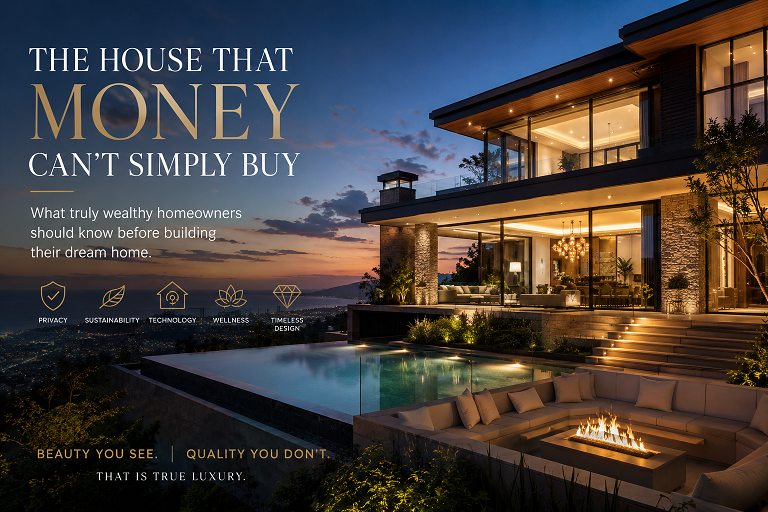
There is a difference between an expensive house and a truly extraordinary home.
An expensive house can have imported marble, a spectacular kitchen, a swimming pool, a twelve-car garage and a price tag that makes people stop and stare.
But none of those things, by themselves, make a home exceptional.
A truly exceptional home is something else.
It is a place that feels as though it could exist nowhere else.
It fits the land.
It understands the climate.
It protects the privacy of the family.
It makes everyday life easier.
It remains comfortable when the power goes out, when the rain comes down hard, and when Cebu’s heat becomes unforgiving.
It anticipates how the family will live five, ten and twenty years from now.
And most importantly, it is built so well that the things you spent the most money on are often the things your guests will never see.
That is the paradox of luxury construction.
The most expensive parts of a great house are often invisible.
You Can Buy a Beautiful House. You Have to Build a Great One.
For many affluent families, buying a luxury house is relatively simple.
There are properties available.
But building a truly personal residence is a different proposition.
A custom home on a premium lot in Maria Luisa, Priveya Hills, Nivel Hills or another exclusive Cebu community may involve architecture, structural engineering, geotechnical investigation, site development, retaining structures, drainage, waterproofing, mechanical and electrical systems, security, technology, landscaping, pools and numerous specialist trades.
The house may look effortless when it is finished.
Getting it to that point is anything but effortless.
And this is particularly true on Cebu’s hillsides.
Maria Luisa, for example, is renowned for its elevated terrain and sweeping views—but that same terrain can make construction considerably more demanding. Architectural coverage of homes in the community has highlighted precisely this challenge: spectacular hillside sites can require highly thoughtful structural and architectural responses.
This is why a luxury home should never be treated simply as a larger version of an ordinary house.
It is an engineered environment.
The New Definition of Luxury
Luxury used to be easy to recognize.
Bigger.
Higher.
More expensive.
More imported materials.
More bedrooms.
More cars.
More everything.
But the definition of luxury is changing.
Recent Philippine luxury-property commentary points toward a different future: affluent homeowners increasingly value privacy, personalization, wellness, sustainability, smart technology, resilience and long-term livability.
That changes the question.
Instead of asking:
“How impressive will my house look?”
The more sophisticated question is:
“How exceptionally well will my house live?”
That is a much more interesting question.
The Luxury You Don’t See
Imagine two houses.
Both have beautiful facades.
Both have imported stone.
Both have designer kitchens.
Both have infinity pools overlooking Cebu.
From the street, they could appear equally impressive.
But underneath one of them is:
- properly investigated soil
- carefully engineered foundations
- properly designed retaining structures
- comprehensive stormwater management
- redundant drainage
- high-quality waterproofing
- properly sized electrical infrastructure
- backup power
- water storage
- sophisticated plumbing
- intelligent HVAC
- appropriate insulation
- carefully designed glazing
- surge protection
- provisions for solar and batteries
- properly coordinated structural and architectural systems
The other house simply has expensive finishes.
Which one would you rather own ten years later?
That is the difference between decoration and engineering.
Your ₱50-Million House Is Not a ₱50-Million Pile of Finishes
This is one of the biggest misconceptions in luxury construction.
A large construction budget does not mean that you should simply upgrade every visible material.
The smartest allocation of money is much more complicated.
Some of your budget goes into the architecture.
Some into structure.
Some into site development.
Some into mechanical and electrical systems.
Some into waterproofing and drainage.
Some into windows and doors.
Some into kitchens and bathrooms.
Some into landscaping and outdoor living.
And some should be deliberately reserved for the things you cannot predict today.
Because custom construction almost always contains surprises.
Especially when the site is steep, difficult to access, geotechnically complicated or exposed to heavy rainfall.
The goal isn’t to spend the most money.
The goal is to spend the money where it creates the greatest long-term value.
The Most Expensive Mistake You Can Make
It isn’t choosing the wrong marble.
It isn’t choosing the wrong paint.
It isn’t even choosing the wrong kitchen cabinets.
The most expensive mistake is starting construction before the project has been properly thought through.
A beautiful architectural drawing is not enough.
Before construction begins, a serious luxury-home project should answer questions such as:
How strong is the ground?
Has the site been properly investigated?
Where does the rainwater go?
Not just during an ordinary rain—but during an exceptional storm?
How will the hillside behave?
Are retaining structures properly designed?
How will the house remain comfortable?
What are the strategies for heat, ventilation, shading and cooling?
What happens when the power fails?
Can essential systems continue operating?
What happens when the family grows older?
Can the home adapt?
What happens if the owners want solar, batteries or electric vehicles later?
Was the infrastructure designed with the future in mind?
What happens when something eventually needs repair?
Can critical systems be accessed without destroying finished spaces?
These questions aren’t glamorous.
But they are the questions that separate a beautiful house from a great house.
The 20-Year House
If you’re spending serious money on a custom home, don’t design only for the family you are today.
Design for the family you may become.
Children eventually grow up.
Parents grow older.
Families change.
People work from home.
Guests arrive.
Cars become electric.
Technology changes.
Energy costs change.
Climate conditions change.
A home that is truly well designed should be able to adapt.
That might mean planning for:
- an elevator or future elevator installation
- wider circulation routes
- aging-in-place features
- flexible bedrooms
- a home office
- dedicated technology spaces
- EV charging
- solar installation
- battery storage
- larger electrical capacity
- improved water storage
- smart-home infrastructure
- security upgrades
- future renovations without major structural alterations
Luxury is not just having everything today.
Luxury is having the freedom to adapt tomorrow.
Cebu’s Climate Changes the Equation
A luxury home in Cebu isn’t a luxury home in California, Singapore or Europe.
The architecture has to respond to Cebu.
Heat.
Humidity.
Heavy rainfall.
Typhoons.
Intense sunlight.
Power interruptions.
Water management.
Corrosion.
And, on many premium hillside sites, difficult terrain.
This means that some of the most important design decisions happen long before the first decorative tile is selected.
Where does the building sit?
How does it capture prevailing breezes?
Where does the afternoon sun hit?
How is rainwater collected and discharged?
Where are mechanical systems located?
How are exposed materials protected?
How is water prevented from entering the structure?
How is the site stabilized?
These are not secondary questions.
They are part of luxury.
The Quietest House Can Be the Most Luxurious
There is another trend emerging in high-end residential design.
The wealthy homeowner increasingly doesn’t need the house to announce its price.
Privacy itself becomes valuable.
A quiet bedroom.
A shaded terrace.
A garden nobody outside the family can see.
A living room that opens completely to nature.
A kitchen that disappears when entertaining is finished.
A private wellness area.
A pool that feels like a resort without leaving home.
A house where technology works silently in the background.
This is why the next generation of luxury homes may actually become less ostentatious and more sophisticated.
The technology disappears.
The mechanical systems disappear.
The security disappears.
The house simply works.
And Then There Is the View
This is one thing money cannot manufacture after construction.
A great site is irreplaceable.
A spectacular view.
A mature landscape.
Privacy.
Elevation.
Orientation.
Natural light.
A sense of arrival.
These are assets.
And once you own an extraordinary site, the house should be designed around it—not imposed upon it.
This is one reason premium hillside communities such as Maria Luisa have produced some of Cebu’s most architecturally distinctive residences. Individual homeowners have been able to create highly personal houses that respond to the terrain and views rather than conforming to a standardized house model.
The land should tell the architect what the house wants to become.
Don’t Ask Your Contractor Only, “How Much?”
If you’re about to build a luxury home, there is a more useful conversation to have.
Don’t ask only:
“How much per square meter?”
Ask:
“What are we building, why are we building it this way, and what could go wrong?”
Ask what assumptions are being made.
Ask what has been investigated.
Ask where the risks are.
Ask what is included.
Ask what isn’t included.
Ask how changes will be handled.
Ask how quality will be controlled.
Ask how waterproofing will be tested.
Ask how drainage will be designed.
Ask how the structure responds to the site.
Ask what happens after turnover.
And ask:
“If this were your own home, what would you refuse to compromise on?”
The answer to that question can tell you a great deal.
Because Your Home Is More Than a Structure
A luxury home is where your family will wake up.
Where your children will grow up.
Where parents and grandparents will gather.
Where important celebrations will happen.
Where business decisions may be discussed over dinner.
Where grandchildren may eventually run through the garden.
It may be one of the largest financial investments your family ever makes.
But its value isn’t measured only in pesos.
A great home becomes part of a family’s story.
That is why the objective shouldn’t be to build the biggest house you can afford.
It should be to build the best house for the life you intend to live.
The Ultimate Luxury
Perhaps the ultimate luxury isn’t marble.
It isn’t a bigger garage.
It isn’t a designer kitchen.
It isn’t even the address.
It is confidence.
Confidence that the home was designed specifically for your family.
Confidence that the site was properly understood.
Confidence that the structure was properly engineered.
Confidence that water will go where it is supposed to go.
Confidence that the systems behind the walls were not treated as afterthoughts.
Confidence that the house can evolve with your family.
Confidence that twenty years from now, you will still be glad you built it.
And when the architecture, engineering, craftsmanship and technology all work together so naturally that you rarely think about them—
that is luxury.
Not the kind that needs to be displayed.
The kind that is simply experienced.
If You Are About to Build Something Extraordinary
For homeowners considering a major custom residence in Cebu, the most important decision isn’t the tile, the kitchen, the pool or even the facade.
It is assembling the right team before construction begins.
The architect establishes the vision.
The engineers make that vision safe and buildable.
The contractor brings the entire system together in the real world.
And the homeowner’s job is to demand that every part of the project—from the foundation beneath the ground to the technology hidden inside the walls—deserves the same level of thought as the parts everyone sees.
Because when you’re building a home of exceptional value,
you shouldn’t settle for a house that merely looks expensive.
Build one that is exceptionally well made.
Cebuano Designers and Builders — Building for the life behind the walls.

Feedback